Document 01 · Confidential
Rev 0.9 · Pre-production

AshenRift

WORKING TITLE

An isometric dark fantasy ARPG · Mobile and PC cross-play · Loot-driven endgame built on the Rift war

I
Section I

The Core
Gameplay Loop

A dark fantasy ARPG lives or dies on the round trip the player makes every day. Everything below is built so the daily session always feeds the seasonal one, and the seasonal one always sends the player back into the Rift.

Plate I
The Three Rings

Daily inside, weekly in the middle, seasonal on the outside. The node marked in amber is today. The whole diagram is one clockwise motion: the daily feeds the weekly, the weekly fills the season, the season resets and starts again.

TODAY AMBER NODE SEASONAL · 8 WEEKS · RESET WEEKLY · LOCKS · RAIDS DAILY · 12 TO 18 MIN
Daily ring12 to 18 min · bounties, 2 to 4 Elder Rifts
Weekly ringDungeon + raid lockouts, guild raid window
Seasonal ring8 weeks · Void ladders reset · economy respires
Today nodeAmber · the Rift you enter now

The rings are concentric because the player never leaves one to enter another. Clearing a daily bounty advances the weekly raid attunement and, in the last fortnight of a season, feeds the Void push directly.

PLATE I · THE THREE RINGS · LOOP CADENCE
Note 01 This is the retention hinge of the whole game. The daily loop must be completable in 12 to 18 minutes on a phone in one hand. Do not nerf it to chase a streamer.

The game is three nested loops: a daily loop the player can clear before the commute ends, a weekly loop that gives the endgame its rhythm, and a seasonal loop that resets the ladder and the economy every eight weeks. The player never has to think about which one they are in. The Rift decides.

1.1 · The Daily Loop

Roughly twelve to eighteen minutes, doable in a queue, in bed, or on the couch. It exists to pay the player for showing up and to push them one step further into a build.

Bounties3 of 5
Elder Rift runs2 to 4
Ash Mark capDaily
Faction dailies1 set
Guild check-in1
Expected XP1 level / 2 days
First clear bonusRiftglass
Session length12 to 18 min
Entry costFree

The daily loop hands out three currencies: XP and gear from the Rift itself, Ash Marks from bounties and faction dailies, and a small trickle of Riftglass from the first clear of the day. Ash Marks are the workhorse currency; Riftglass is the premium-adjacent one, and it drops slowly enough to feel like an event.

1.2 · Endgame Loops

Once the campaign ends, three doors open. They are not equal, and they are not meant to be. Dungeons and raids are the scheduled, social endgame. The Rift system is the everyday, solo-friendly, endlessly repeatable floor beneath them.

DungeonsStructured 4-player runs. Fixed layouts, a rotation of modifiers, and a weekly lockout on the best gear. The training ground for raid mechanics.
Raids8 to 12 players. Multi-phase boss encounters with strict coordination checks. Weekly lockout. The aspirational ceiling and the main driver of guild life.
RiftsThe endless floor. Abyssal Rifts for farming and crest investment, Void Rifts for the ranked push. No lockout, no ceiling, always available. Detailed in Plate II.

1.3 · Progression Hooks

Four hooks, each pulling a different kind of player forward. A build is never finished; it is always one more Rift from being sharper.

Progression Matrix
HookWhat it rewardsCadenceCeiling
Hero LevelStat points, skill runesContinuousSoft cap per season
ParagonSmall passive nodes, no capContinuousNo hard cap
Gear and SetsBuild identity, affixed powerPer sessionRift-tier gated
Legendary GemsLong-horizon power and ResonancePer CrestRank 10
Void LadderStanding, cosmetics, upgrade currencyPer 8 weeksVoid 150+
Every session should end with the player one decision away from a better build. That decision is the game.
Plate II · The Endgame Core
Rift Systems Architecture

Two Rift families share one system. Abyssal Rifts are the farming floor: generative, chaotic, and crest-fed. Void Rifts are the ranked climb: fixed, cold, and infinite. They are labelled, and they are never distinguished by color alone.

Abyssal Rifts · Farming and Crest Investment

Randomly generated three-level dungeons. Kill elite packs to fill a progress meter before the timer runs out, then spawn the Rift Guardian and finish it. Shifting biome modifiers rewrite the run every time.

Rotating biome roll SHATTERED CATHEDRAL · BLOOD SWAMPS · GRAVEMARCH · BELLFOUNDRY · THE ORPHAN FENS
Structure3 levels · generative
Timer10:00 · progress meter
Spawn conditionElite packs fill meter
BossRift Guardian
CrestsConsumable · party-wide
10:00 RIFT TIMER L1 · APPROACH L2 · ELITE PACKS L3 · GUARDIAN METER FILLS ON KILLS
Void Rifts · Ranked Leaderboard Push

Fixed-difficulty, non-crest rifts with infinite scaling. Zero gear drops from trash mobs. Everything the run is worth compiles into a single Loot Chest, and the only question is how deep you can push before the clock closes.

Scaling ladder VOID 1 → VOID 150+ · INFINITE · NO BIOME VARIATION
StructureFixed · no regeneration
Timer15:00 · Loot Chest
Trash dropsNone · zero gear
RewardOne Loot Chest on Guardian kill
LaddersSolo · 2P · 4P · reset 8 weeks
15:00 VOID TIMER LOOT CHEST ALL REWARDS FUNNEL HERE
The Crest Investment · Consumable Rift Crests

Crests are slotted before entry and modify the whole party for the run. They are the deliberate risk dial: pay in, and the run answers with a guaranteed drop and a harder roll on every modifier beneath it.

Common Crest
Guarantees 1 Rune drop. Minor party buffs, or enemy speed bonuses that raise the pace and the risk.
+1 Rune guaranteedParty buffsEnemy speed up
Legendary Crest
Guarantees 1 Legendary Gem drop. High-tier modifiers that rewrite the arena itself.
+1 Legendary Gem guaranteedLava PoolsVolatile Minions
Legendary Crest · Two-Step Roll
Note 02 This is the gem economy's heart and the highest-stakes number in the game. Every roll is two gates, and the second gate only opens on a 5-Star base. Pity is what keeps the worst night tolerable.

A Legendary Crest does not roll a gem directly. It rolls the Gem Tier first. Only if the tier comes up 5-Star base does it roll the Quality Rating, measured in Filled Stars. The percentages below are per Legendary Crest, exactly as specified.

Step 1 · Gem Tier from one Legendary Crest
TierChance
1-Star75.395%
2-Star20.105%
5-Star base4.500%
Total100.000%
Step 2 · Quality when a 5-Star base drops
Filled StarsOf 5-StarOverall
2/5 Stars75.0%3.375%
3/5 Stars20.0%0.900%
4/5 Stars4.0%0.180%
5/5 Stars1.0%0.045%
Hard Pity · 50 Crests
If no 5-Star base gem drops within 49 consecutive Legendary Crest uses, the 50th is guaranteed to drop one. A 5-Star base at 5/5 quality works out to roughly 1 in 2,222 Crests. Bound Legendary Crests and Unbound Eternal Legendary Crests each track their own pity counter, separately.
Legendary Gems · Gem Power and Rank Progression

Gems are crushed into Gem Power (GP), the base upgrade resource. Upgrading a gem needs Gem Power plus Rank 1 or ranked duplicates of that same specific gem. The conversion and the three upgrade tables below are given as specified; cells the source left incomplete are marked for confirmation and no figure has been invented.

Gem Power conversion · Rank 1 crush value
Crush to Gem Power
Gem (Rank 1)Gem Power
1-Star Rank 11 GP
2-Star Rank 14 GP
5-Star Rank 1 (any quality)32 GP
2-Star Legendary Gems · Rank 1 to Rank 10
Upgrade table · 2-Star · confirmed this pass
Target RankGP CostDuplicate CopiesCumulative GPRank 1 Copies Used
Rank 21 GPNone2 GP1
Rank 35 GPNone7 GP1
Rank 410 GPNone17 GP1
Rank 515 GPNone32 GP1
Rank 620 GP1 × Rank 153 GP2
Rank 725 GP1 × Rank 179 GP3
Rank 830 GP1 × Rank 1110 GP4
Rank 940 GP1 × Rank 1151 GP5
Rank 1050 GP1 × Rank 1To be confirmedTo be confirmed

Rank 10 duplicate count and cumulative GP were not present in the source and are flagged for confirmation. No value has been inferred.

5-Star Legendary Gems · Rank 1 to Rank 10
Upgrade table · 5-Star · includes Resonance column
Target RankDirect GPDuplicate CopiesCumulative GPRank 1 Copies UsedResonance Granted
Rank 1BaseNone32 GP130 ?100 ?
Rank 250 GPNone82 GP1110 - 200
Rank 375 GP1 × Rank 1189 GP2190 - 300
Rank 4100 GP1 × Rank 1321 GP3270 - 400
Rank 50 GP1 × Rank 1 + 2 × Rank 3731 GP8350 - 500
Rank 60 GP3 × Rank 3 ?1,298 GP14430 - 600
Rank 70 GP2 × Rank 3 + 1 × Rank 52,407 GP26510 - 700
Rank 80 GP2 × Rank 3 + 1 × Rank 53,516 GP38590 - 800
Rank 90 GP1 × Rank 3 + 2 × Rank 55,167 GP56670 - 900
Rank 100 GP1 × Rank 3 + 2 × Rank 5To be confirmedTo be confirmedTo be confirmed

Flagged cells: Rank 1 cumulative GP and Resonance were written with a dash and are recorded as 32 GP and 100. Rank 6 duplicate line was ambiguous, recorded as 3 × Rank 3. Rank 10 cumulative GP and Resonance were not in the source. None have been invented.

1-Star Legendary Gems · Upgrade table
The 1-Star Rank 1 to Rank 10 upgrade table is still to come from the source. It is left as a placeholder rather than filled with estimates. When the 1-Star figures arrive, the row structure matches the 2-Star table above.
Cross-Play Matchmaker · Party Scaling

The matchmaker scales the encounter with the party. Monster health and damage rise by +40% per additional player; drop quantity rises by +15% per member. Two series, two line styles, labelled directly, no legend box.

100%150% 200%250%300% 1 PLAYER2 PLAYERS 3 PLAYERS4 PLAYERS 140 180 220 115 130 145 SOLID · MONSTER HEALTH / DAMAGE · +40% PER ADDITIONAL PLAYER DASHED · DROP QUANTITY · +15% PER MEMBER
Note 03 Bosses are where the raid lives or dies. Each wipe mechanic must be solvable by four strangers who have never spoken. If it needs a callout, it needs a telegraph.
Boss Dossier · Raid Encounters

Raid Bosses

Three encounters, sourced from the design chat and reproduced as given. Names, numbers and mechanics are kept exactly as written. Encounters are read in order.

Boss 1

Malakor

The Grand Inquisitor · Two phases · Party wipe mechanic at 20% HP
Phase 1 · 100% to 60% HPJudgment of Light

Visual telegraph: Malakor raises his dual-bladed staff. A sweeping golden cone (120-degree sector) tracks the aggro holder for 2.5 seconds, then pulses.

Core ability, Executioner's Slash: heavy physical damage to the tank. Grants a stacking Fractured Armor debuff (+15% damage taken) that forces tank-swaps at 3 stacks.

Environment hazard: holy banners along the walls continuously radiate golden waves across the room floor, to be dodged with dash abilities.

Phase 2 · 60% to 20% HPBlinding Wrath

Transition: Malakor plunges his staff into the arena centre, shattering the floor and revealing a floating obsidian platform surrounded by an endless abyss.

New ability, Sound Sensing: Malakor goes blind. A blue ring surrounds each player and expands when they cast spells or move. Malakor instantly teleports to and executes any player whose ring reaches maximum size. Players must slow their DPS and stop casting during his Listening Stance.

Party wipe mechanic · The Grand Inquisition · triggers at 20% HP
Malakor channels a room-wide holy Nova for 12 seconds. 4 holy glyphs light up around the arena border.
Solve: all 4 players must simultaneously step onto separate glyphs within 8 seconds to project a protective barrier over the party.
Failure: if any glyph is unassigned when the channel ends, the Nova deals 999,999 Holy Damage and wipes the party.
Boss 2

Arch-Lich Vulgath

Sovereign of the Decay · The Spire of Whispering Bones · DPS race and minion / adds management
Phase 1 · 100% to 50% HPNecrotic Harvest

Visual telegraph: green spectral lines connect Vulgath to all 4 party members for 3 seconds, then he summons crawling corpse-minions at their feet.

Core ability, Plague Bomb: targets the farthest player with an expanding green circle. When it expires it leaves a permanent pool of toxic sludge on the ground.

Phase 2 · 50% to 0% HPBody of Decay

Transition: Vulgath absorbs all active minions on the field, gaining +2% damage output per minion consumed and expanding in size.

Enrage modifier: every 30 seconds, one quadrant of the floor lights up green and is submerged in acid, shrinking the safe fighting area.

Party wipe mechanic · Army of the Damned · every 90 seconds in Phase 2
Vulgath summons 4 giant Bone Golems at the cardinal edges. They walk toward him over 15 seconds.
Solve: burst down at least 3 of the 4 before they reach him.
Failure: if 2 or more reach him, he detonates their marrow for room-wide shadow damage equal to 100% of player max health per surviving golem.
Boss 3

Valgoroth the Flame-Scorched

The Void-Forged Dragon · Caldera of the Fallen Titan · Positioning, coordination and soft-enrage mastery
Phase 1 · 100% to 75% HPLava Stream

Visual telegraph: Valgoroth turns toward a random quadrant and reels back his head as red magma cracks glow along his chest for 3.5 seconds.

Core ability, Magma Breath: a 180-degree cone of molten lava dealing heavy Fire damage and applying a permanent Burn stack (-10% Fire Resistance).

Phase 2 · 75% to 25% HPAir Phase and Void Corruption

Transition: Valgoroth takes flight, circles the arena and rains void-infused meteors that leave temporary black hole anomalies on the ground.

Core ability, Gravity Pull: black holes pull players toward their centre. Standing in one inflicts rapid Void damage but cleanses all Burn stacks accumulated in Phase 1.

Phase 3 · 25% to 0% HPMolten Meltdown · soft enrage

Transition: Valgoroth lands violently and breaks the platform edges. Lava rises from the bottom of the arena at a rate of +5% of arena surface covered per 10 seconds.

Party wipe mechanic · Extinction Breath · triggers at the Phase 2/3 transition
Valgoroth channels a 10-second apocalyptic blast down the centre lane of the arena.
Solve: use the black holes spawned in Phase 2 as gravity anchors, standing behind them so the void anomaly absorbs the heat ray.
Failure: any player caught in the line of sight without a black hole buffer is incinerated instantly.
Further encounters
Boss design is still to come from the source. The dossier opens space for more encounters here as they arrive.
II
Section II

Character
Classes

Four proposals, not four skins. Each is built around a resource that behaves differently in the hand, so the moment-to-moment feel of the class is carried by the meter as much as by the kit.

Note 04 Read each class by its silhouette at phone distance: the shape has to be legible in the two seconds before the player decides to attack it. Material first, colour last.

The roster is deliberately hostile: a builder, a spender, a harvester and a resister. If two classes ever want the same resource loop, one of them is wrong. Names and kits are proposals, open to the room.

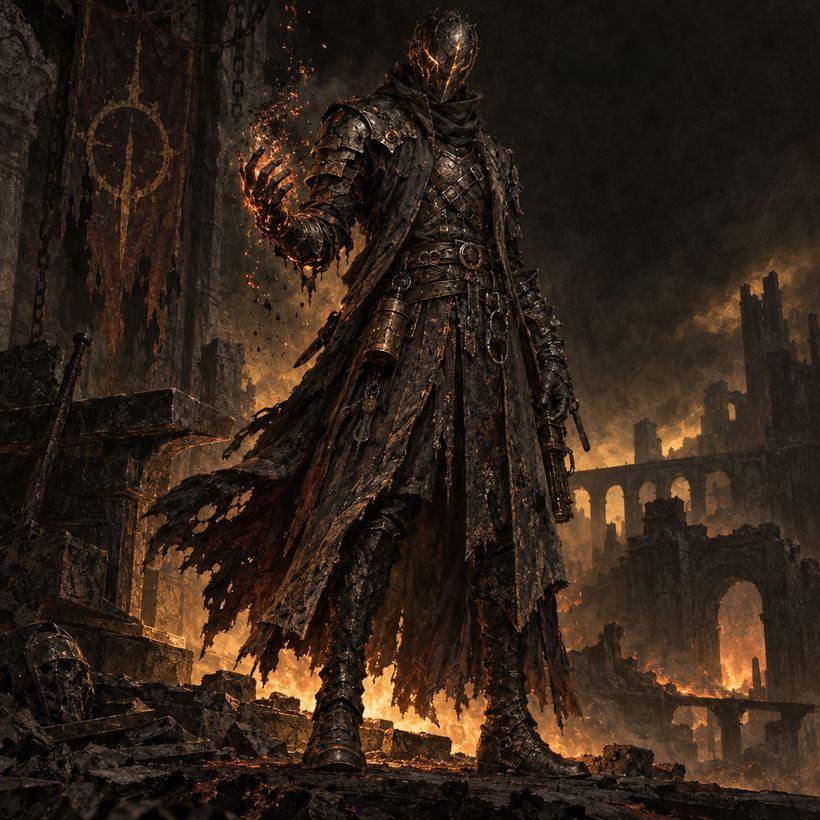
Cinderwright
Class I · Proposed · Ranged / Zone

The furnace that never quite goes out. Every hit lays down fuel; the player spends it in one burning decision.

Primary ResourceAsh
Builds on damage dealtDecays over timeSpent to Ignite
Signature PassiveEmber Ledger

Ash gained is increased by 20% while below half health. The class is rewarded for standing in the wreckage.

Active IIgnite

Spend all stored Ash to set a target alight, burning for damage scaled to the Ash spent.

Active IICinder Veil

Consume Ash to drag a trail of embers that slows anything crossing it.

01 Cinderwright concept art: a forge-sorcerer in cracked blackened plate with amber cracks
ART DIRECTION · Ash-stained iron over scorched leather, amber rim from below, ash airborne
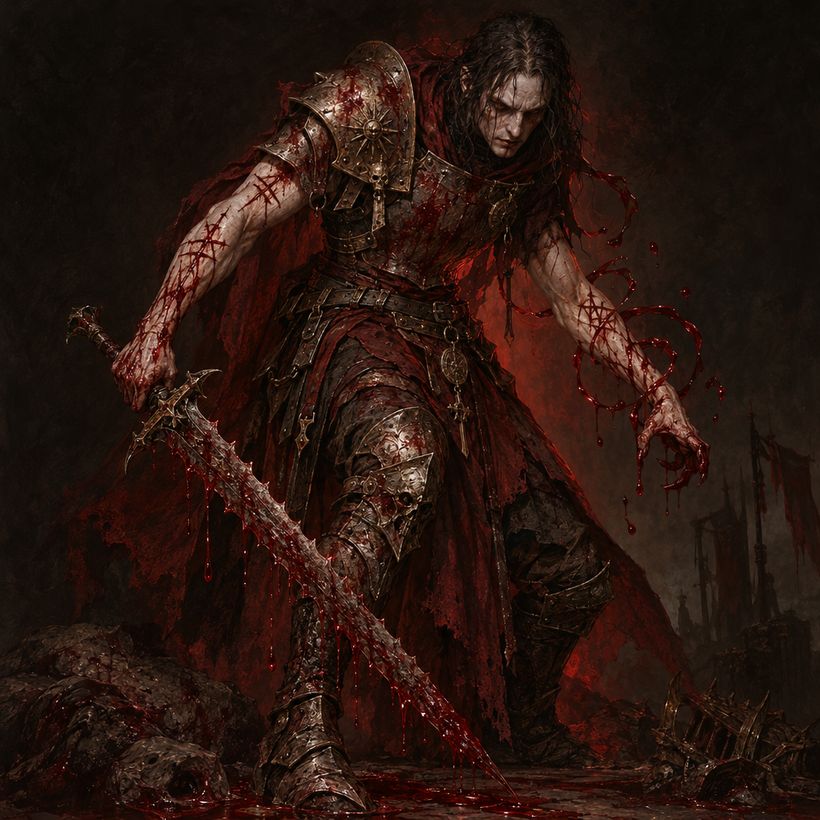
Sanguine
Class II · Proposed · Melee / Bruiser

Pays for power in the only currency it trusts. Every ability is a wound the player chooses to open.

Primary ResourceHealth
Spent as lifeRefunded on killsNever regenerates idly
Signature PassiveBlood Price

Abilities cost health instead of resource. Killing an elite refunds 30% of the cost as a heal.

Active IExsanguinate

Open a burst wound on a target, draining them into a pool that can be walked through to heal the party.

Active IICrimson Aegis

Convert a large chunk of current health into a shield that reflects a portion of damage taken.

02 Sanguine concept art: a blood-knight in crimson half plate with a dripping serrated blade
ART DIRECTION · Dried blood on old leather, exposed scarified forearms, red rim, low aggressive stance
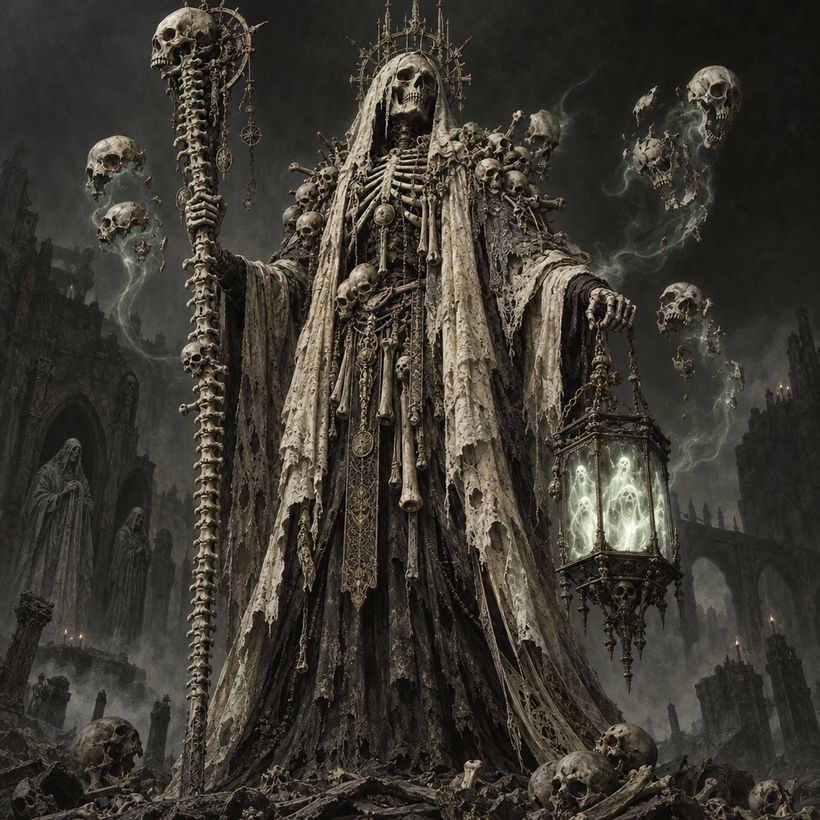
Ossuary
Class III · Proposed · Summoner / Support

Harvests what the party leaves behind, then spends the dead to keep the living upright.

Primary ResourceSouls
Harvested from the slainStored up to a capBanked, not decayed
Signature PassiveGrave Tithe

Every enemy slain within the party's radius adds a Soul, regardless of who landed the killing blow.

Active IBone Tide

Spend Souls to raise a line of skeletal hands that pin and bleed anything caught in their reach.

Active IISoul Lantern

Bank a Soul into a lantern that can be passed to an ally, shielding them for its duration.

03 Ossuary concept art: a skeletal necromancer in funerary rags with a vertebra staff and a lantern of souls
ART DIRECTION · Ivory bone and grave dust, funerary cloth, sickly green-white rim, lantern carries the only glow
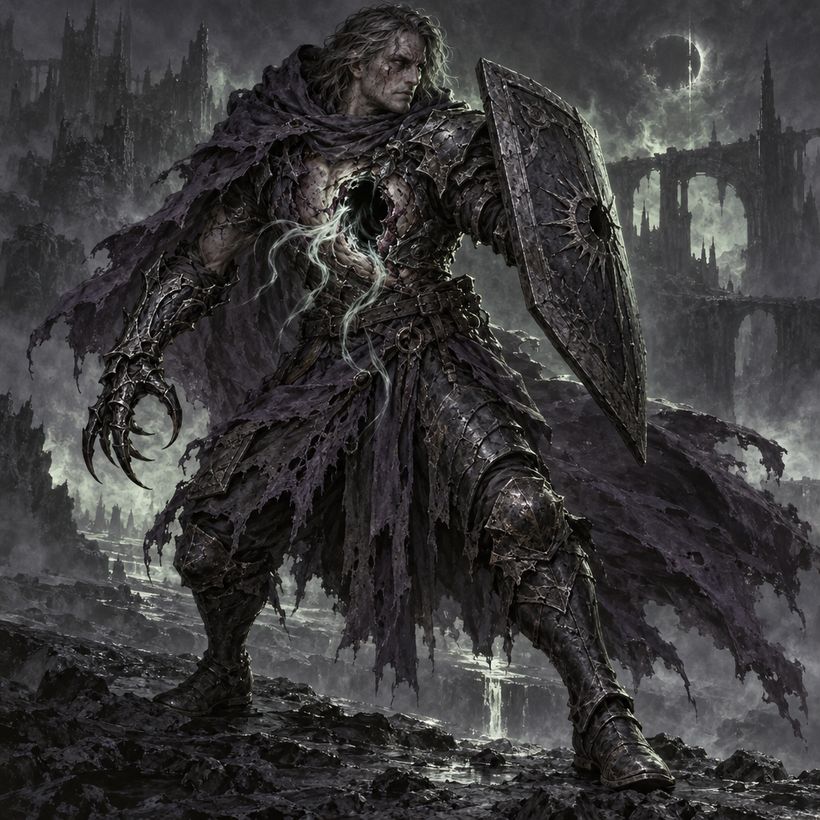
Riftbound
Class IV · Proposed · Tank / Counter

Turns punishment into ammunition. The deeper the wound, the more the class has to spend.

Primary ResourceDread
Gained by taking damageDecays out of combatSpent on reprisal
Signature PassivePain Conduit

A portion of damage dealt to nearby allies is redirected to the Riftbound and converted into Dread.

Active IRift Step

Spend Dread to blink through an enemy, leaving a tear that pulls nearby foes toward it.

Active IIVoid Reprisal

Discharge all stored Dread as a shockwave scaled to the damage taken since last cast.

04 Riftbound concept art: a scarred warrior with a living void tear in the chest and a clawed gauntlet
ART DIRECTION · Cracked obsidian plate over rags, pale corpse-light bleeding from the chest wound, cold rim, shield arm forward
Note 05 The four meters below are the real balance levers. Tune fill and decay rates before touching damage numbers; the kit reads differently at the same DPS.
Resource identity at a glance
Class roster · proposed
ClassResourceGainBehaviourPlaystyle
CinderwrightAshOn damage dealtDecays, spent to IgniteBuilder / zone control
SanguineHealthAlways therePaid in blood, refunded on killsMelee bruiser
OssuarySoulsFrom the slainBanked, no decaySummoner / support
RiftboundDreadOn damage takenDecays out of combatTank / counter
III
Section III

Monetization
and Economy

A ledger, not a store page. The job of this section is to say plainly what is earned, what is bought, and where the line is drawn.

Note 06 Write the firewall in the design doc and hold it. The day the store wants a stat, this page is the thing that says no. Currency buys pace and expression, never the ceiling.
Power is earned in the Rift and sold nowhere. We sell time, expression and pace. We never sell gear, stat power, or a ladder standing.

The model is hybrid free-to-play: a generous free path that reaches every power ceiling in the game, and a paid path that reaches it faster and looks better doing it. The player's ability to win a fight is never for sale.

Note 07 Conversion from Ash Marks to Riftglass must be capped daily, or the soft currency becomes a second premium currency and every sink in the game breaks.
The Ledger · Free path against paid path
What each path reaches
LayerFree pathPaid path
Campaign and levellingFull access, no gatesNo shortcut sold
Gear and setsAll drops earnable in RiftsNo gear sold at any tier
Legendary GemsEarned from Crests and eventsCrest bundles, faster pity
Battle PassFree lane every seasonPremium lane, cosmetics and currency
CosmeticsSome earnable via ladder and eventsShop catalogue, no stat effect
Void ladder standingEarned onlyNever sold
Currency Flow · Ash Marks to Riftglass and the sink for each
BOUNTIESFACTION DAILIESRIFT CLEARS ASH MARKS SOFT · EARNED CONVERT · CAPPED DAILY ASH MARKS → RIFTGLASS RIFTGLASS PREMIUM · PURCHASABLE BATTLE PASS COSMETIC SHOP CREST BUNDLES CRAFTING · UPGRADES · REPAIRS
Plate III
Season Track · Battle Pass

A three-month track, two lanes. The free lane carries real currency and materials; the premium lane adds cosmetics and accelerates the same rewards. Ticked once per season.

Season StartWeek 4Week 8Season End · Reset
Free
Premium
Free lane · Riftglass trickle · crafting mats · one cosmetic Premium lane · full cosmetic set · currency · portrait frame
PLATE III · SEASON TRACK · 3 MONTHS · TICKED PER SEASON
Note 08 The Legendary Crest is the one item the store is allowed to sell that touches power at all, and only indirectly: it changes the odds, never the ceiling. Treat its price with the care of a balance change.
Item Plate · Legendary Crest
TypeConsumable · slotted pre-entry
Guarantee1 Legendary Gem
ModifiersHigh tier · Lava Pools, Volatile Minions
ScopeWhole party
Pity50 uses · separate Bound / Eternal counters
Sold asCrest bundles · earned in events free
Note 08b The auction house is where the game stops pricing a player's time for them. It is a market, not a shelf, and the moment players set the price, the design has to answer for every number it hands out.
Player Auction House · A Proposed Player Market

A player-driven market inside the game. Players list gems, gear and other items, and buy from each other. Nothing on the shelf is authored by us: what is listed, and what it costs, comes from the players who found it.

The proposal reads as two shelves. A common shelf trades gems and ordinary items between any players. Above it sits a veteran shelf: higher-tier gear worn only at max level, found by high-level players in the game and sold through the auction house to other high-level players.

Auction house · proposed shelves
ShelfSourced byWorn byBought byPriceCurrency
Common shelfAny playerAny playerAny playerSet by playersTo be confirmed
Veteran shelf · top-tier gearHigh-level players · found in gameMax level onlyHigh-level playersSet by playersUSD
HIGH-LEVEL PLAYER FINDER · FOUND IN GAME LISTS AUCTION HOUSE PRICE SET BY PLAYERS BUYS HIGH-LEVEL PLAYER BUYER · MAX LEVEL SETTLEMENT · USD
GoodsPlayer-found gear
PricesSet by players, not fixed by the game
Trade currencyUSD · as answered
MechanismProposal · not confirmed
Unresolved · where the veteran shelf comes from
The wording pulls two ways. Top-tier gear is described as something players grind for and find in the game, and also as gear obtainable only through the auction house. Whether the auction house is the only door to it, or one of several, is left open on purpose. Both readings are recorded; neither is chosen here.
Open questions carried forward
The real-money side was raised first as USD or bitcoin; the recorded answer is USD. What the common shelf trades in, and whether the veteran shelf changes hands only between players who already own it, remain to be settled.
IV
Section IV

Controls
and Combat

One combat verb set, three inputs. The mobile overlay has to survive a phone held in one hand; the PC map has to feel native; and the same word must name both.

Note 09 Every thumb target sits inside a soft hit radius larger than its drawn size. A control the player misses twice is a control they blame the game for.

The touch layout is drawn to scale on a phone held in portrait. The skill wheel and the joystick own the bottom corners, because those are the only places a thumb rests without moving the grip. Everything else is a hotspot inside reach.

HIT
RADIUS
SKILL
WHEEL
JOY
STICK
TARGET
LOCK
DODGE
POTION
SWAP
MoveW A S DkeyboardL·STICKgamepad
Primary SkillLMBkeyboardXgamepad
Skill Wheel1 2 3 4keyboardA B X Ygamepad
DodgeSPACEkeyboardBgamepad
Target LockTABkeyboardR·TRIGgamepad
PotionQkeyboardD·PADgamepad
InventoryIkeyboardSTARTgamepad

The keycap map above is the PC face of the same layout. The mobile wheel maps one to one onto the four skill keys, so muscle memory carries across the cross-play boundary.

Note 10 Read this table one row at a time. If a verb needs a different word on two inputs, the verb is the problem, not the input.
Master Input Table · one verb across all three inputs
Action · Touch · Gamepad · Keyboard
ActionTouchGamepadKeyboard
MoveVirtual joystick, bottom-leftLeft stickW A S D
Primary attackTap skill wheel hubALeft mouse
Skill 1Wheel segment, upper-leftX1
Skill 2Wheel segment, upper-rightY2
Skill 3Wheel segment, lower-rightB3
Skill 4 · ultimateWheel segment, lower-leftR bumper + B4
Dodge / dashLeft hotspot, midBSpace
Target lockRight hotspot, midRight triggerTab
Potion / swapCentre-bottom hotspotD-pad downQ
InventoryMenu, top-rightStartI
V
Section V

Social and
Guild Systems

The Rift is where players go alone, and the war is what they come back to tell people about. Three social layers: the faction war that runs all season, the guild raid that runs all week, and the ladder that resets every eight weeks.

Note 11 The faction map is a persuasion device. It has to look like a map a soldier would pin to a wall, with borders that move because someone moved them, not because an event fired.

Faction war is the seasonal meta-layer: two factions contest a territory board, and every Rift run contributes a small amount of pressure to a contested border. Guild raids are the weekly commitment. The Void ladder is the individual climb that resets and starts again.

Plate IV
Faction War · Territory Schematic

Hand-drawn territory board. Two factions hold solid ground; the borders between them are hatched, because they are contested and move every season.

ASHFALL COMPACT HELD · 62% OF BOARD PALE CHOIR HELD · 38% OF BOARD CONTESTED BORDER MOVES WITH RIFT PRESSURE THE FENS WHISPERING SPIRE THE RIFTMOUTH LEGEND SOLID: HELD HATCH: CONTESTED
PLATE IV · FACTION WAR · TERRITORY SCHEMATIC
Note 12 A guild raid roster that fills itself is no roster at all. The slots have to be a visible promise: this is who shows up, and this is what they bring.
Guild Raids · Roster Board

Eight to twelve-player encounters with fixed role slots. A guild signs up as a board, and unfilled slots are visible to the whole roster before the weekly window opens.

Roster board · 12-seat raid · this week
SlotRoleAssignedStatus
Slot 1Main TankCinder-09Confirmed
Slot 2Off TankRiftbound-VConfirmed
Slot 3Main HealerOssuary-LinConfirmed
Slot 4Off HealerOpenSeeking
Slot 5DPSSanguine-KadeConfirmed
Slot 6DPSSanguine-RookConfirmed
Slot 7DPSCinderwright-AmeConfirmed
Slot 8DPSOpenSeeking
Slot 9SupportOssuary-ValeConfirmed
Slot 10DPSRiftbound-SolConfirmed
Slot 11DPSOpenSeeking
Slot 12FlexOpenSeeking
Note 13 The reset cut is the whole point of a seasonal ladder. Make it visible on the page so players feel the floor they are about to land on.
Competitive Ladders · Void Season

Solo (per class), 2-Player and 4-Player Void ladders share one frame. Rewards are grants by percentile, and the eight-week reset is a hard horizontal cut across every ladder at once.

RANK 1 TO 1%
Title badge · premium portrait frame · premium upgrade currency
1% TO 10%
Title badge · portrait frame · premium upgrade currency
10% TO 30%
portrait frame · premium upgrade currency
30% TO 60%
portrait frame
60% TO 100%
participation reward · season currency
8-WEEK RESET · LADDERS CLEAR · SEASON CLOSES
Solo · per classFour separate ladders, one per class, so a class is never carried by the roster around it.
2-PlayerA shared ladder. Coordination is scored as heavily as raw clear depth.
4-PlayerA shared ladder. The deepest Void push, and the highest coordination ceiling.
Ashen Rift
Working title · design dossier · rev 0.9
Document · 01 · Core concept
Sections · I to V · plus Plates I to IV
Status · Pre-production · open to the room
Note · Figures marked to be confirmed are left open, not guessed

Prepared as a concept document for review. All class kits and economy figures are proposals unless reproduced from the source brief, which is marked as given.